Facing the Stream

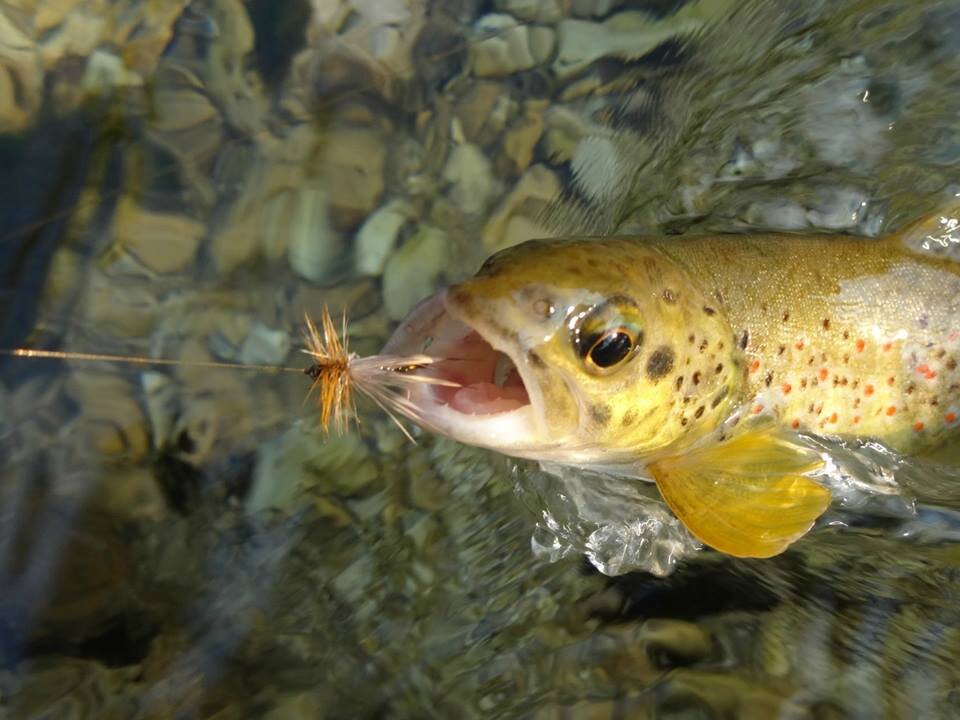
Dry fly fishing in fast-moving waters is the most sporting aspect that the art of fly fishing offers. But success in these places can only be achieved by scrupulously following those strict rules that the stream has written and imposes
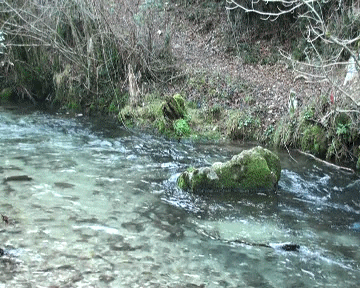
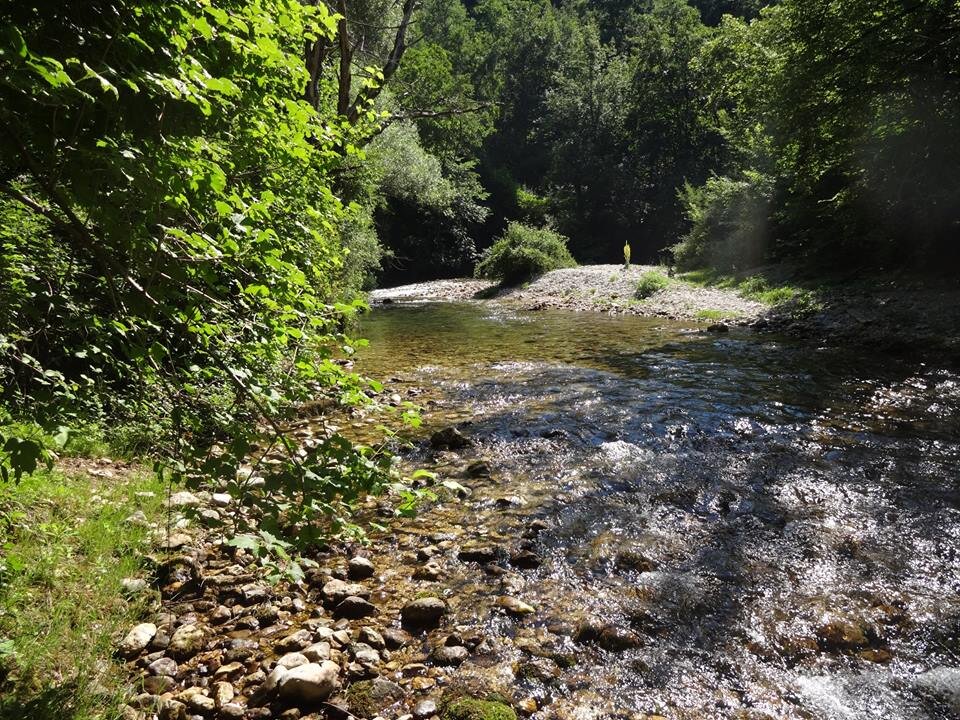
Since always, the turbulent waters of the stream have divided dry fly fishermen due to the difficulties of approach they impose. This force of nature, which releases an infinite number of currents and liquid veins, requires a great commitment from the fisherman who, beyond his experience and mastery of technique, must necessarily complete himself with the entire 'stream environment.' To complete oneself, or rather to integrate with the stream, in fact, means to mentally enter into the mechanisms that regulate life with it, to understand its rhythms, to know its potential, but at the same time it is essential to also know our own limits. The stream, in fact, is not a river in which the two parts, water and fisherman, live separated each in their own environment, thus far from the patterns and rules that govern the life of the other, but is practically the opposite. The stream is experienced from within, directly, with an exchange that I would define as biological, in which the fisherman must necessarily enter. In short, fisherman and water must merge into one thing. When a fisherman feels all these things and recognizes himself in the stream as his other natural element, then integration has taken place. To ensure that this discourse is complete, it is necessary to adhere to some rules, and it is on these, that is, on their perfect knowledge, that the success of dry fly fishing in streams is based.
These can be summarized as:
1) Cast short.
2) Know the currents.
3) Know the role of the stones.
4) Know the path of the food. (during hatching and hunting).
5) The approach.
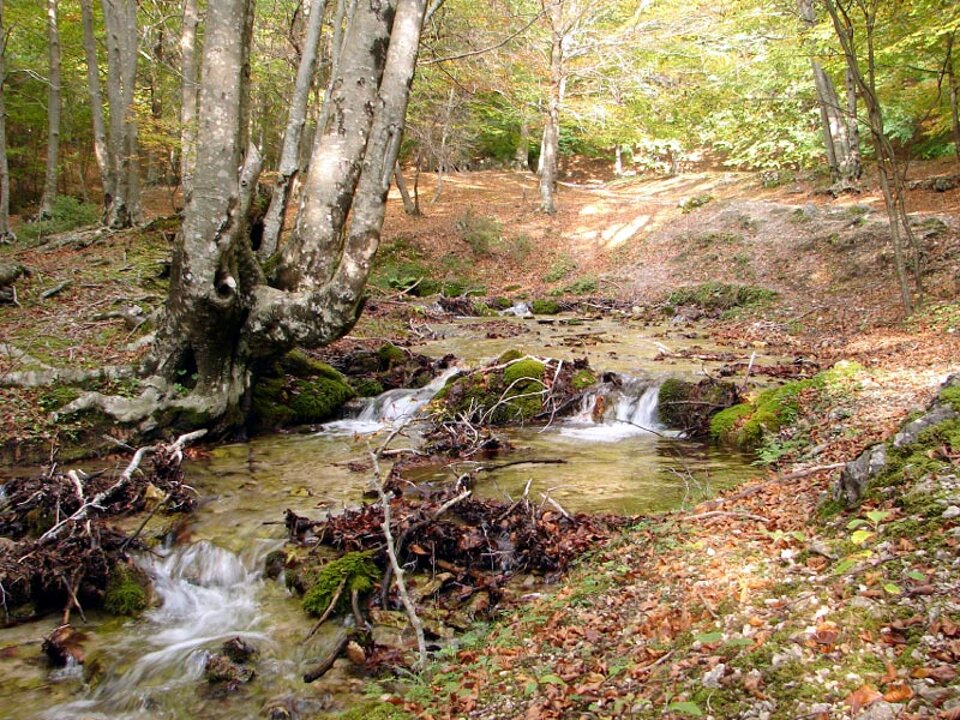
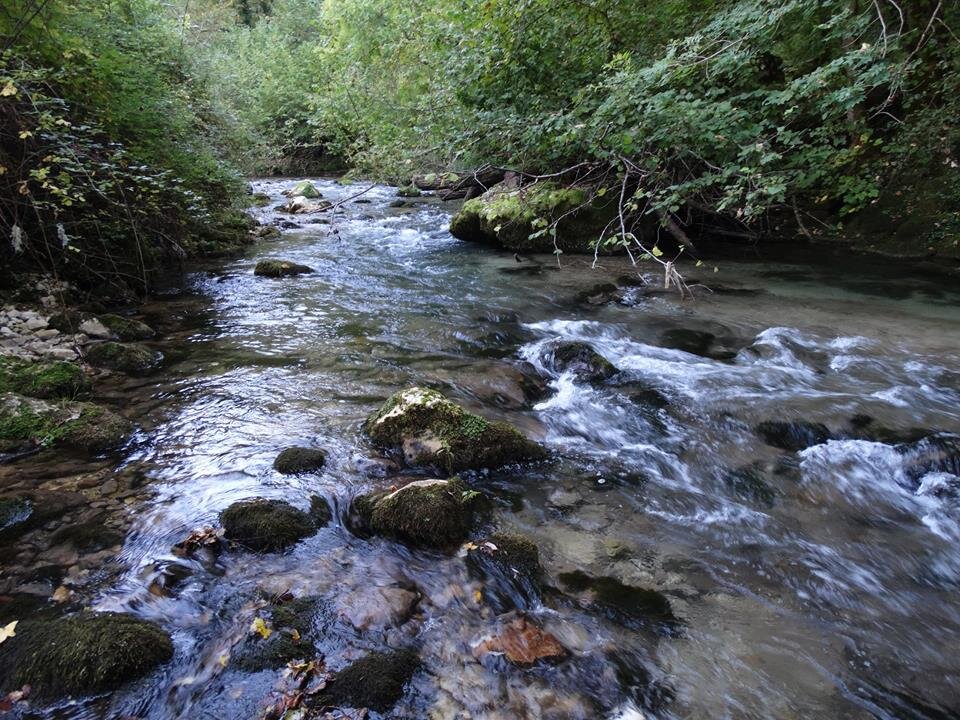
Basically, these five elements are the foundation for being able to tackle the stream and the vehicles for perfect integration with it. Let's start analyzing them. Why cast short? I think everyone has already answered this question because casting long involves many problems with drag. In general, in a stream you need to cast short, beyond skill, which becomes that extra weapon to overcome those situations where mastery of the equipment is required to come out 'unscathed' from the most varied situations. Cast short and, if possible, not straight but with a presentation, as they say in jargon, 'cut', that is, so that the fly is presented to the trout in the best way, with the line and leader as far as possible from the trout's sight. The other rule, that is, knowledge of the currents, is very important because it allows you to understand which ones are the most dangerous for fly drag. The stones scattered here and there in the water, which are also a contributing factor to negative elements such as drag, also have a positive role in dry fly fishing, which, if exploited properly, helps to overcome difficult situations such as drag. These, and I urge those who do not have great technique to exploit them, should be used to the fullest and can be the element of success. The important thing is to identify the 'positive' ones, that is, the right ones for this purpose. But the stones, the 'negative' ones, cause drag, and these too must be identified and avoided. The trout's food becomes the basic vehicle for studying and then identifying the very important hunting spots. Now, they must be split into two parts: the right one for the hatch and the other fundamental one for the hunting spot, which may take different paths depending on the place you are in. Last, but first in importance, is the approach. Approaching the hunting spot properly is the foundation of everything. Moving clumsily and making awkward movements makes it useless to have scrupulously followed the other rules mentioned above. These five points can be considered a sort of decalogue on which dry fly fishing in streams is based, fundamental matrices on which to build fishing operations and from which the tactics arise, which, more than ever in these waters, are so important.
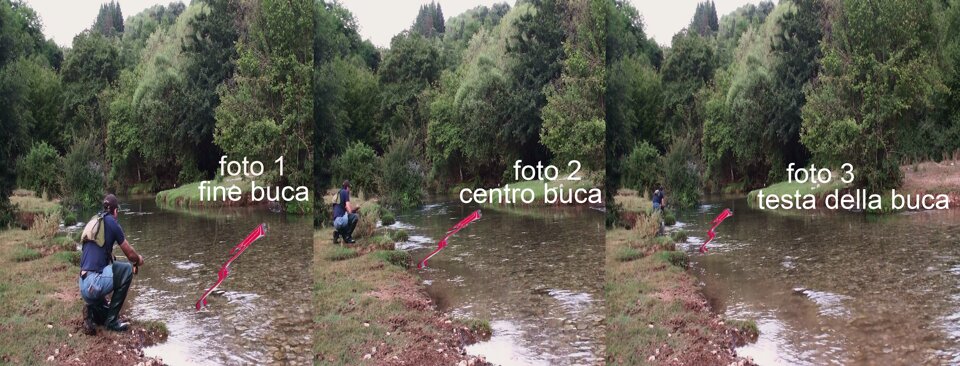
HOW TO APPROACH A POOL: A COMPLETE TACTIC.
To attack a pool, it is necessary to use what I would call a complete tactic which, in a certain way, is the result of the rules just described, rules that inevitably all come into play together. In other words, in a stream you cannot exclude some or just one of these in advance, but all of them are fused together at the same time. This is a fundamental aspect in dry fly fishing, an aspect that absolutely must become part of the angler's integration with the stream.
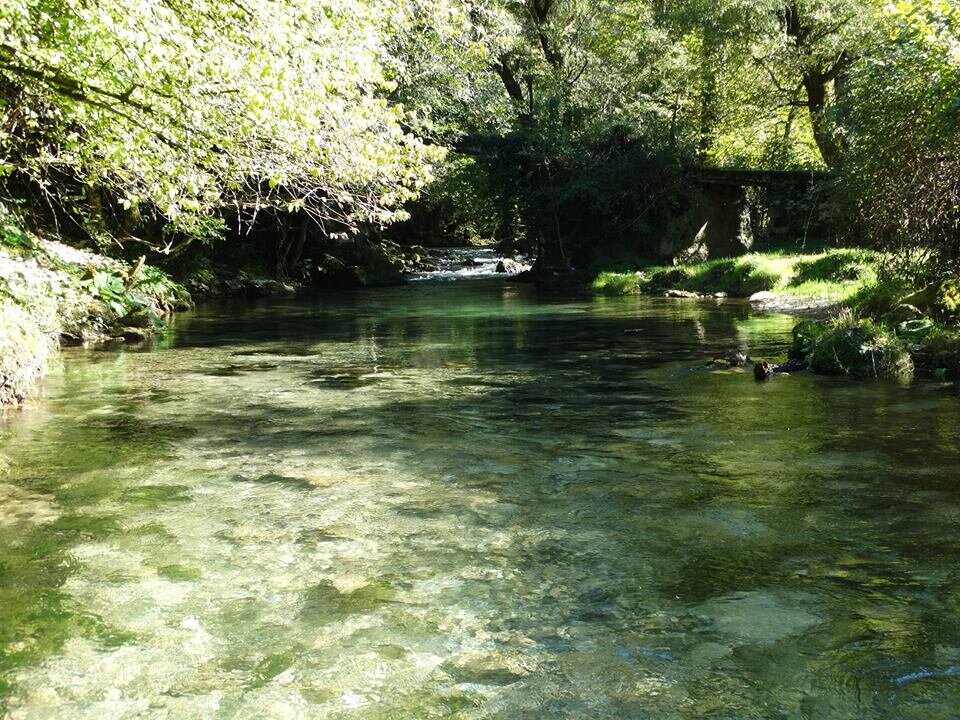
The pool must therefore be approached taking into account everything just mentioned, but first it is necessary to analyze the period when a hatch is taking place, and when it is not. Let's start with the second situation, which is also the most frequent. First of all, the pool should be divided into three well-defined areas, starting from downstream: the tail of the pool, the center of the pool, and the head of the pool. Secondly, for each area, the trout's feeding zones should be identified and a priority of attack assigned to each of them. In other words, you should prioritize the feeding zones where you cast, following a precise criterion, which, generally speaking, is to fan out starting from the one closest to you.